
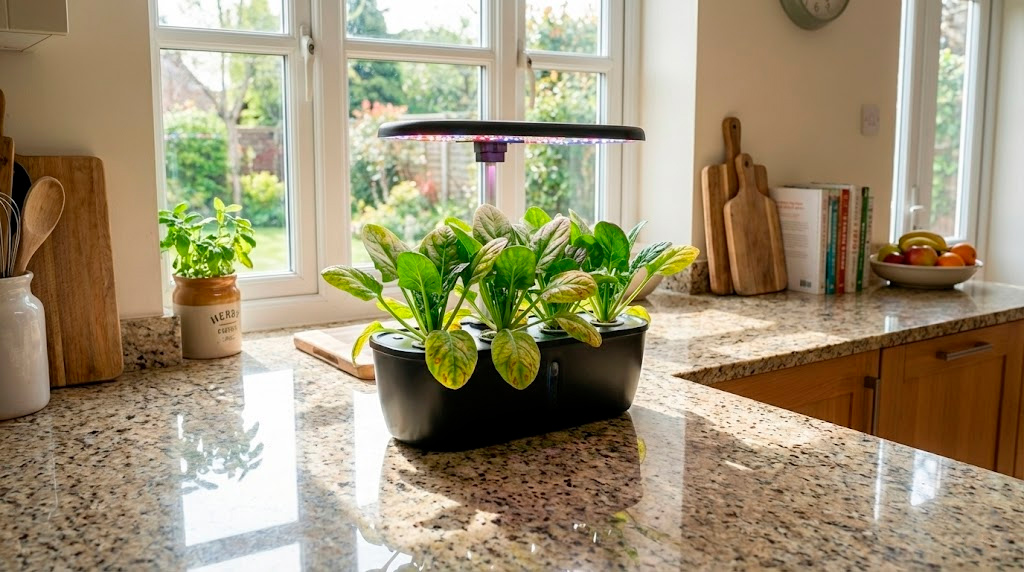
One of the clearest signs that something is off in your SmartGarden is a change in color. When leaves lose their vibrant green or mysterious spots appear, it’s easy to panic.
But in hydroponics, where plants live in a controlled chemical solution, these changes are a direct form of communication. Your plant isn’t dying — it’s sending you a message: “I need iron,” “The water is too acidic,” or “I’m too hot.”
In this guide you’ll learn to read that color map and correct it before it’s too late.
Note: This article includes AI-generated images and illustrations to enhance your reading experience.
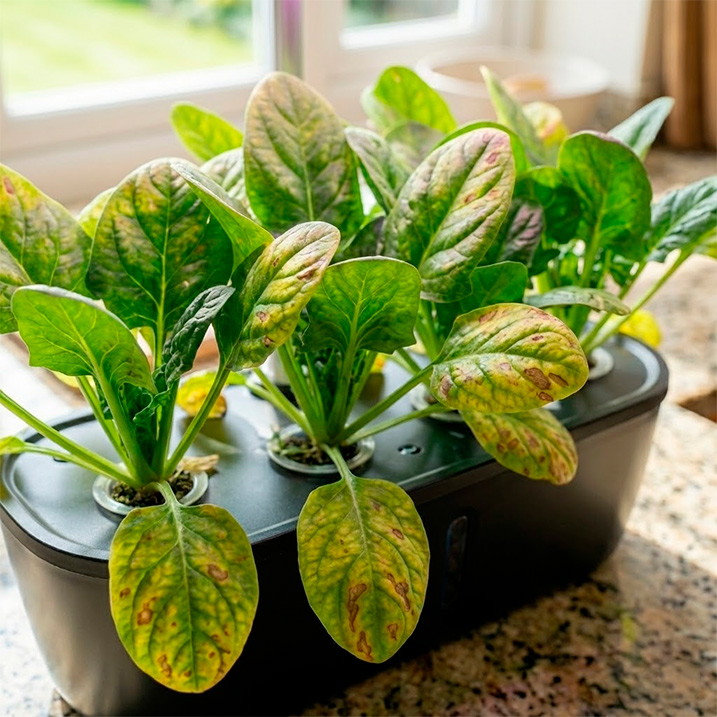
The usual suspect: nutrients or pH?
Before rushing to add more fertilizer, there’s something fundamental to understand. Yellow leaves (chlorosis) can stem from two very different causes:
- True lack of food: There aren’t enough nutrients in the water.
- pH lockout (the most common): There’s plenty of food in the tank, but the pH is off. If pH rises above 6.5 or drops below 5.5, it acts like a lock that shuts the plant’s mouth. Even with a tank full of fertilizer, the plant starves.
Diagnosis map: where the problem appears
To figure out what’s going on, you need to look at where the problem shows up. Plants are smart: if they’re lacking a mobile nutrient like nitrogen, they pull it from the old leaves to give it to the new ones.
1. Old leaves (the bottom ones) turn yellow The leaf turns yellow evenly, starting from the tips, and eventually falls off. The new leaves up top look fine.
Diagnosis: Nitrogen deficiency. The plant is “cannibalizing” its old reserves to keep growing. Fix: Check the pH and, if it’s correct, slightly increase the nutrient dose or refresh the tank if the solution is old.
2. New leaves (the top ones) come in yellow Leaves that just emerged come in yellow or very pale. Sometimes the veins stay green while the rest of the leaf is yellow (interveinal chlorosis).
Diagnosis: Iron or micronutrient deficiency. These nutrients are “immobile” — the plant can’t move them from bottom to top. The cause is almost always high pH (above 6.5). Fix: Lower pH to 6.0.
3. Rust-colored brown spots or dry tips Brown spots, dry edges, or a burnt-paper look.
- On the tips: Nutrient burn. Lower the dose.
- Spots in the middle of the leaf (common in tomatoes and peppers): Calcium and magnesium deficiency. Add a dedicated Cal-Mag supplement.
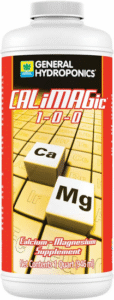
General Hydroponics CALiMAGic Quart
4. White or bleached spots on the upper leaves Dry, white, or transparent patches only on the leaves closest to the lamp.
Diagnosis: Light burn. Fix: Raise the LED lamp 2–4 inches.
Symptom summary
| Symptom | Where it appears | Likely cause |
|---|---|---|
| Even yellowing | Old leaves (bottom) | Nitrogen deficiency |
| Yellow with green veins | New leaves (top) | Iron deficiency / pH lockout |
| Burned or dry tips | Throughout | Salt excess (nutrient burn) |
| Brown / rust spots | Middle leaves | Calcium deficiency (Cal-Mag) |
| White or dry patches | Upper leaves | Light too close |
Rescue protocol
If your leaves are asking for help, follow these 3 steps:
Step 1: measure pH (always first)
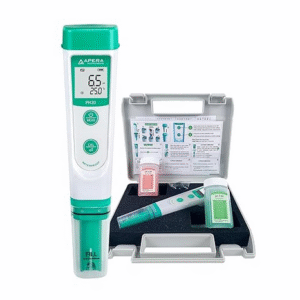
pH Meter Apera Instruments AI209
Before adding anything, measure the pH. The ideal range is 5.8 to 6.2. Many times, simply adjusting the pH is enough to bring the green back within a couple of days.
Step 2: evaluate the nutrient solution
- How long has it been since you changed the water? If it’s been more than 4 weeks, don’t try to fix it — drain everything, clean the tank, and mix a fresh solution. This “reset” solves 90% of problems.
- Have you been topping off with nutrients? This is a very common mistake. When the water level drops, top off with plain pH-adjusted water only. If you top off with water and nutrients together, you’re doubling the salt concentration and can burn the plant.
Step 3: check the environment
- Roots: Are they white? If they’re brown and smell bad, the problem is root-related, not nutrient-related.
- Light: Make sure there’s at least 4–6 inches between the lamp and the tallest leaf.
Patience and observation
Leaves that are already brown or heavily yellowed won’t recover — you can cut them off so the plant doesn’t waste energy on them.
Your goal is to watch the new growth: if the new shoots come in green and healthy, you’ve solved the problem. Learning to read your leaves makes you a better grower, and over time you’ll know what your plant needs with just a glance.